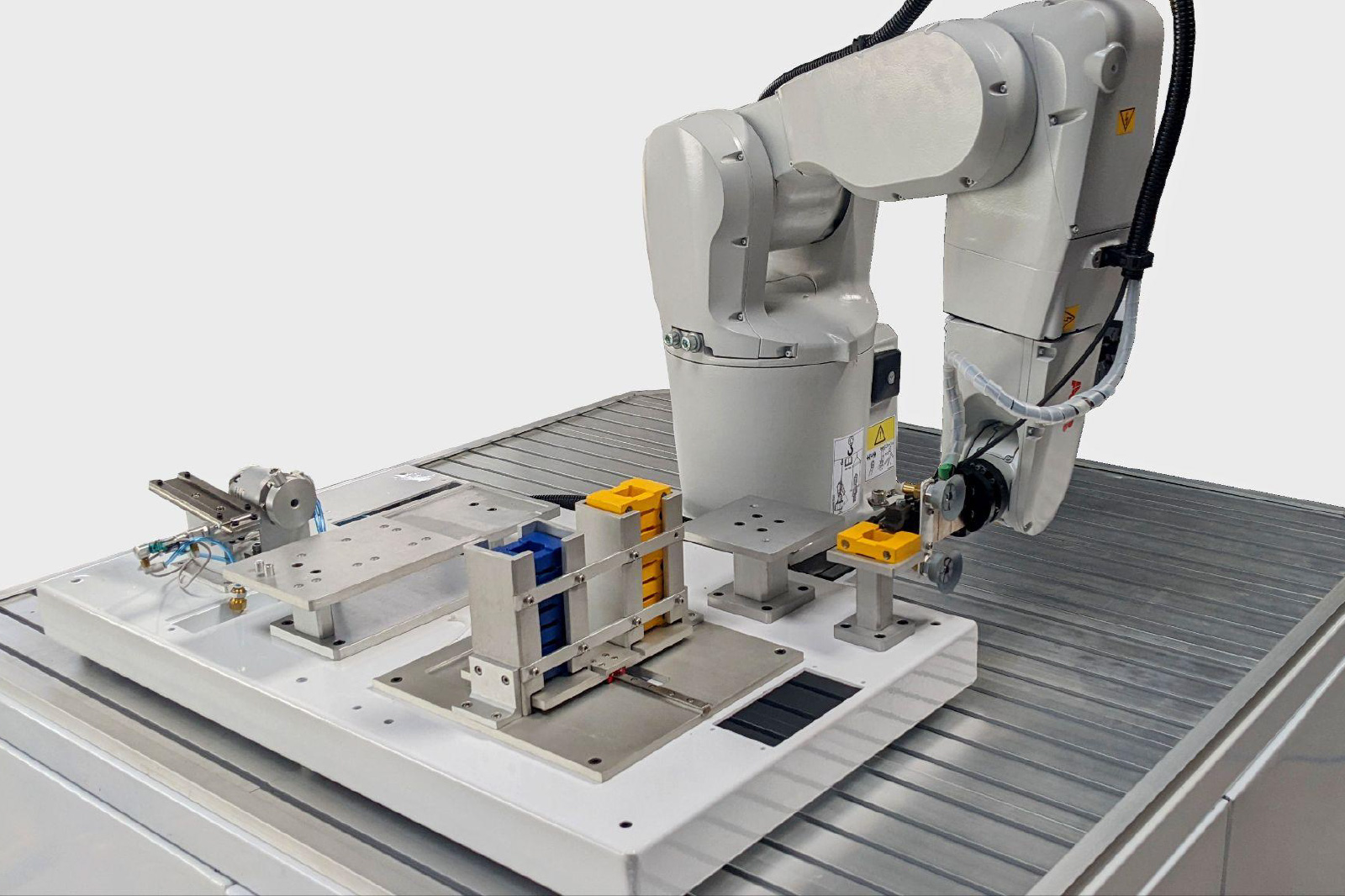
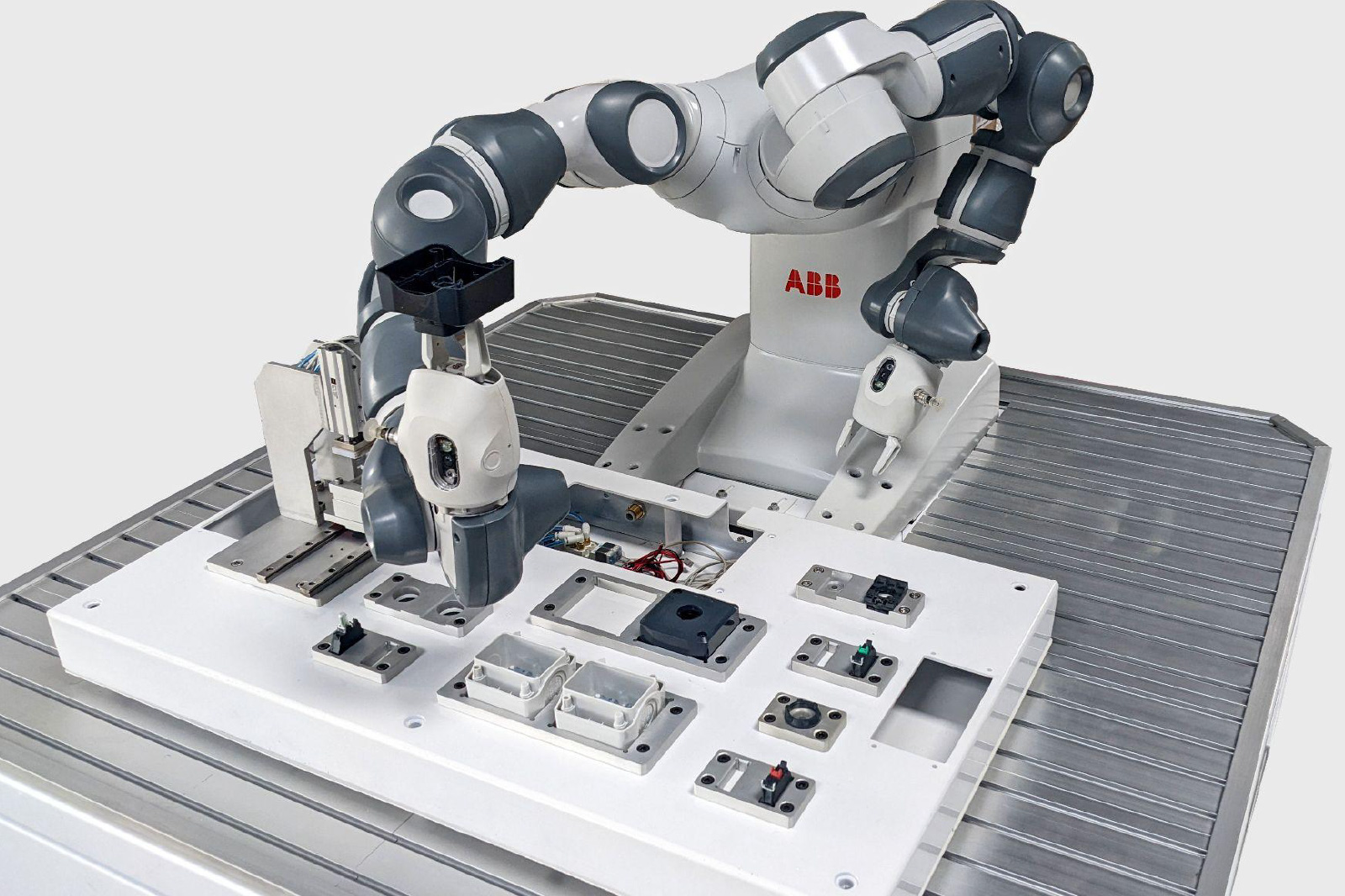
Learning how to use robots is an integral part of today’s engineering curriculum. Several courses such as Robotics & Automation and Mechatronics engineering require the use of robots for hands on training. At Synapse, we have developed a modular training cell which is very advanced and at the same time, simple to use.
The features include
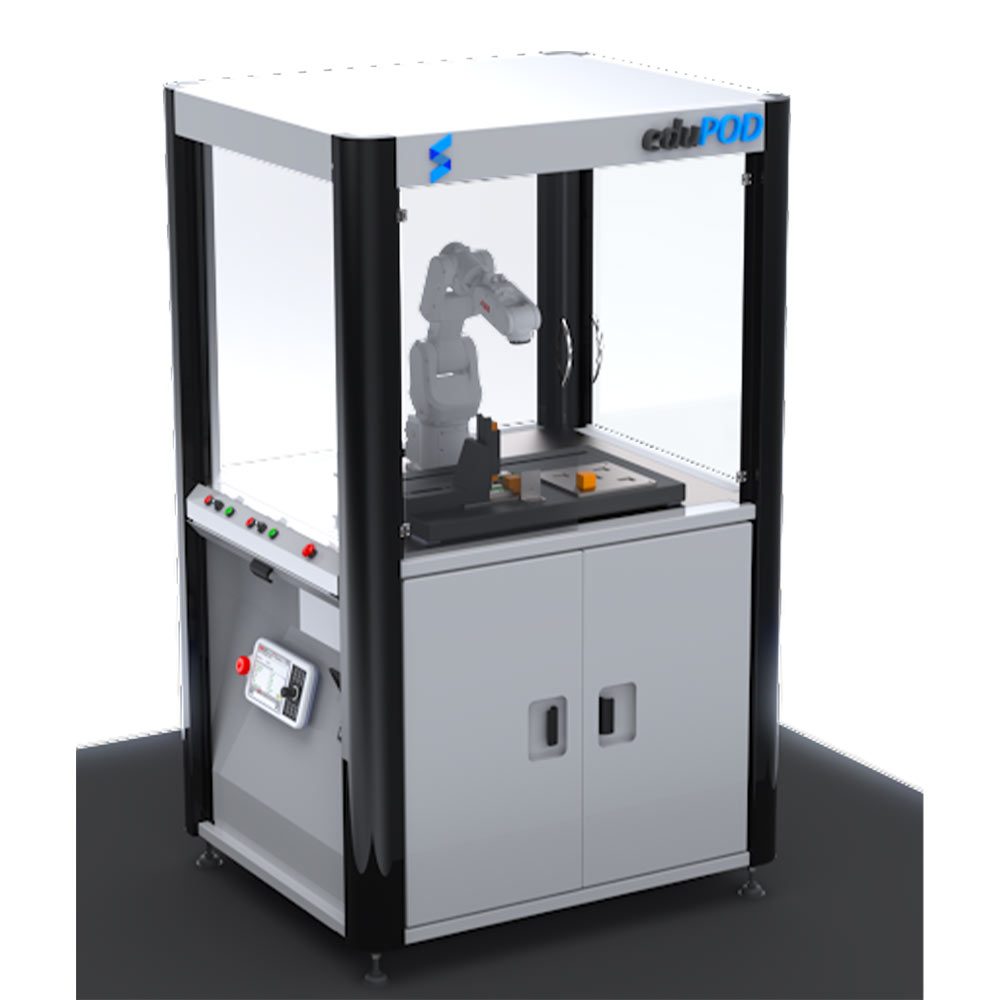
- Portable POD with a compact footprint
- Compact 6 axis robot with 6 kg payload
- Compact controller housed inside the POD
- Modular concept for experiments. Each module is built on a separate frame. The available modules are
- Beginner level modules with grippers and simple pick and place experiments
- Medium level modules with continuous path programming options
- Advanced modules with integrated vision and assembly. Modules can be removed and stored inside the POD when not in use
- Customized modules can be added and at any time for advanced courses
- The system is very flexible and students can get creative and design new modules as and when required
- Optional PLC can be included. This enables students to learn how to interface robots with a PLC. This is a typical requirement for all industrial robotic cells
- Ready to use solution with preconfigured plug and play modules
ROBOTICS TRAINING FOR FUTURE READY FACTORIES
- Prepare your workforce for robotic implementation
- Presence of an Inhouse Training Cell can reduce the cost of training
- We train your trainer. Your trainer trains your workforce
- Team can practice programming safely on the training cell. Reduces potential damage to real projects
- Experiments can be tailor made to mimic processes at your factory.
SUCCESFUL PROJECTS
YEARS OF EXPERIENCE
Industries Served
-
Educational Institutions
Providing hands-on, modular training environments for schools, colleges and universities to teach practical skills in automation, robotics and engineering
-
Technical Training Centers
Offering customizable training solutions to technical institutes, enhancing students’ learning in robotics, CNC machining and automation
-
Manufacturing & Industrial Training Programs
Facilitating workforce development by providing modular training cells that simulate real-world manufacturing processes for employees and apprentices
-
Automotive & Aerospace Industries
Enabling companies to train staff in industry-specific skills such as robotics programming, CNC operations and machine tending in a controlled modular environment
FREQUENTLY ASKED QUESTIONS
EduPod is a modular robotics training cell developed by Synapse Robotics, designed for educational institutions, technical training centres, and manufacturing companies that want to build in-house robotics and automation training capability. It is designed for use in Robotics & Automation and Mechatronics engineering courses, as well as for workforce upskilling in industrial environments. The system is built to be advanced enough for genuine engineering training while remaining simple enough for students to learn on.
EduPod includes a compact 6-axis robot with a 3-6 kg payload capacity. The robot and its controller are both housed within the POD — the controller is integrated inside the compact enclosure, keeping the overall footprint small and the system self-contained and portable.
EduPod is structured around three module levels.
1.Beginner modules use grippers for simple pick and place experiments, giving students a foundation in robot programming and coordinate systems.
2.Medium modules introduce continuous path programming, where students learn to program the robot along defined trajectories.
3.Advanced modules integrate vision systems and assembly tasks, covering the sensor-robot interfaces found in real industrial cells. All modules are built on separate frames and can be removed and stored inside the POD when not in use.
Yes. The modular concept is designed for extensibility — customised modules can be added at any time for advanced or specialised courses. The system is also flexible enough for students themselves to design and create new modules as their skills develop. This means the EduPod can grow with a programme’s curriculum rather than being fixed to a set of pre-defined experiments.
Yes. An optional PLC (Programmable Logic Controller) can be included with the EduPod. This enables students to learn how to interface a robot with a PLC — a fundamental skill for anyone working on industrial robotic cells, where robots almost always operate as part of a PLC-controlled production system. This makes EduPod suitable for preparing students for real-world industrial automation environments, not just standalone robot programming.
EduPod supports several specific benefits for industrial training. It allows a company to prepare its workforce for robotic implementation before or alongside deployment of live systems. Having an in-house training cell reduces the cost of sending employees to external training programmes. The ‘train the trainer’ model means Synapse trains a designated trainer at your facility, who then trains the wider workforce — multiplying the impact of the initial investment. Critically, the team can practise programming safely on the training cell, which reduces the risk of costly damage to live production equipment during the learning phase.
Yes. Experiments can be tailor-made to mimic the specific processes at a customer’s factory. This means training is directly applicable to the work employees will be doing, rather than generic laboratory exercises. For example, a company that uses robots for pick and place tending can configure EduPod modules to replicate that specific task, so employees are training on processes identical to their actual job requirements.
The EduPod is designed to be moved and set up in different rooms or locations without requiring fixed installation infrastructure. The compact footprint means it does not require a large dedicated lab space — it can be deployed in an existing classroom or training room. The modules are stored inside the POD when not in use, keeping the setup tidy and minimising the space required when the system is not running.
EduPod is a ready-to-use solution with preconfigured plug-and-play modules. This means institutions and companies do not need robotics integration expertise to start using it — the system arrives configured and ready for training. Customised modules or advanced configurations can be added, but the out-of-the-box experience is designed for immediate deployment.
Standard industrial robots require a full cell setup, safety fencing, and integration work before they can be used safely for training — and they typically have large footprints that are impractical in a classroom environment. EduPod is specifically designed around training: it is compact and portable, the modules are structured into a learning progression (beginner to advanced), the controller is integrated inside the enclosure, and the system includes the option to add PLC interfacing.