
Liquid pouches present unique challenges in secondary packaging. Their flexible, fluid-filled form makes them prone to deformation and damage when subjected to conventional drop packing methods. At the same time, line speeds in home care, personal care and FMCG manufacturing routinely exceed 100 units per minute, leaving no tolerance for jams, mispacks or product damage downstream.
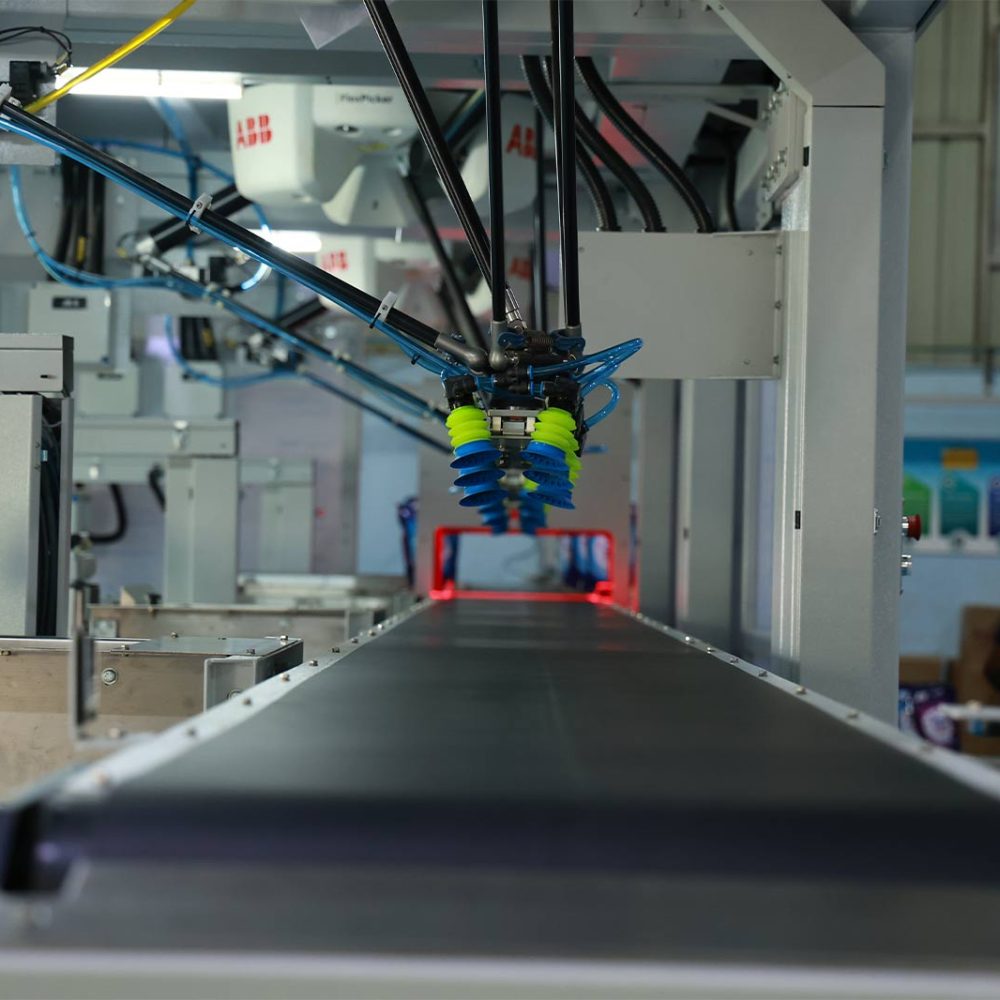
Synapse Robotics has developed a modular robotic case packing solution purpose-built for liquid pouches. Powered by ABB FlexPicker delta robots running ABB Pickmaster software, the system supports both top-load and side-load configurations and handles pouches from 0.5 to 6 litres across home care and personal care product lines including detergents, fabric conditioners, and shampoos.
Complete turnkey case packaging systems can be supplied with the following elements
- Carton erectors. These are dedicated and suitable for high speed lines running the same carton type.
- Product in feed systems and collation conveyors. Both lane type and servo collators are used based on the SKU’s and flexibility required in the system
- Vacuum grippers for gentle handling of pouches
- Additional accessories such as online checkweighers, bar code readers and printers can be integrated into the line
- Bottom and Top sealers
Side Load or Top Load option
The system offers two loading configurations, selected based on the product and line requirements:
• Side Load — Pouches are pushed horizontally into the case from the side, eliminating the impact forces of top-loading. This is the preferred configuration for pouches with thin seals, high fill levels or products sensitive to deformation under gravity. The gentle lateral push maintains pouch shape and prevents seal stress throughout the packing cycle.
• Top Load — Available where line layout or product format suits vertical insertion into the cartons. Suitable for more robust pouch formats
Modular Architechture
Each module houses an ABB FlexPicker robot a servo collator and operates at up to 45 pouches per minute, producing up to 8 packed cartons per minute. Modules can be added as line speed demands increase. Three modules can be clubbed together to produce upto 120 pouches per minute or 25 cartons per minute. This modular approach allows manufacturers to start with a single-module installation and expand without replacing the system. Capacity is matched precisely to the filling line output rather than over-specified from the outset.
Machine compatibility
The system is designed to install directly after liquid pouch filling machines. It is compatible with filling lines from leading manufacturers including Mespack, Leepack & Serac, making it suitable for integration into both new installations and existing production environments. The Synapse system is fully interlocked with the filling lines for fully automated production.
BENEFITS OF ROBOTIC CASE PACKERS
- Flexibility for frequent recipe changes and and new variant addition
- Rapid Changeover - Less than 20 minutes
- Multiple carton sizes can be accomodated on the same line
- Modular scalable solution from 45 UPM to 120 UPM
- Servo Collator supports multi layer martix formation
- Side Load option for gentle handling of pouches
SUCCESFUL PROJECTS
YEARS OF EXPERIENCE
Industries Served
-
Home Care Products
Liquid detergents, fabric conditioners, floor cleaners and dishwashing liquids in pillow and stand-up pouch formats. The side-load configuration is well suited to high-fill-weight pouches such as 4 litre and 6 litre detergent refills.
-
Personal care products
Shampoos, conditioners, body wash and hand wash in flexible pouches.
-
Food & Beverages
Ketchups, Sauces, Fruit juices, baby food purees, pet food and dairy products are all packed in pouches for convenience
-
Edible Oils
Edible Oil pouches are the largest by volume and line speeds exceed 240 pouches per hour. Ideally suited for robotic case packers
FREQUENTLY ASKED QUESTIONS
The system handles liquid pouches from 0.5 to 6 litres. It covers home care and personal care lines including liquid detergents, fabric conditioners, floor cleaners, dishwashing liquids, shampoos, conditioners, body wash, and hand wash. Food and beverage formats like ketchup, sauces, fruit juices, baby food purees, pet food, and dairy are also supported, as are edible oil pouches, which typically run at the highest volumes.
Side-load pushes pouches horizontally into the case, eliminating the impact forces of vertical drop packing. This is the preferred configuration for pouches with thin seals, high fill levels, or products sensitive to deformation under gravity, for example 4 litre and 6 litre detergent refill pouches. Top-load is preferred for lighter pouches which can be directly inserted into the carton.
Each module can handle up to 45 pouches per minute, producing up to 8 packed cartons per minute. Three modules combined deliver up to 120 pouches per minute or 25 cartons per minute. The number of modules depends on the line speed.
Yes. The modular architecture lets you begin with a single-module installation at 45 pouches per minute and add modules as demand increases up to three modules and 120 pouches per minute without replacing the system. This avoids over-specifying capital investment at the start.
The system installs directly after liquid pouch filling machines and is compatible with filling lines from Mespack, Leepack, Serac or equivalent. Our system is fully interlocked with the filling line for automated production. Integration into both new and existing production environments is supported.
Changeover between pouch sizes or carton formats takes less than 20 minutes. Multiple carton sizes can be accommodated on the same line, making the system well suited to manufacturers who run frequent SKU changes or introduce new product variants.
Two design choices address this. Vacuum grippers pick pouches without applying point loads that would deform or stress the seal. The side-load configuration eliminates the vertical drop and impact force of conventional top-load packing a significant advantage for high-fill-weight or thin-seal pouches.