Grey and SG Iron casting fettling is a mandatory operation prior to machining. This process is very labour intensive and hazardous. The dust generated during grinding and the risk of injury during long hours of fettling poses a serious health hazard. If in house fettling capacity is insufficient, components have to be sent out to third party suppliers for fettling. This non value added transport and loading/unloading process increases the cost per component. The inventory cost also adds up.
High payload foundry specification robots can be utilized to effectively fettle castings. The robots can run 24/7 and provide consistent results.
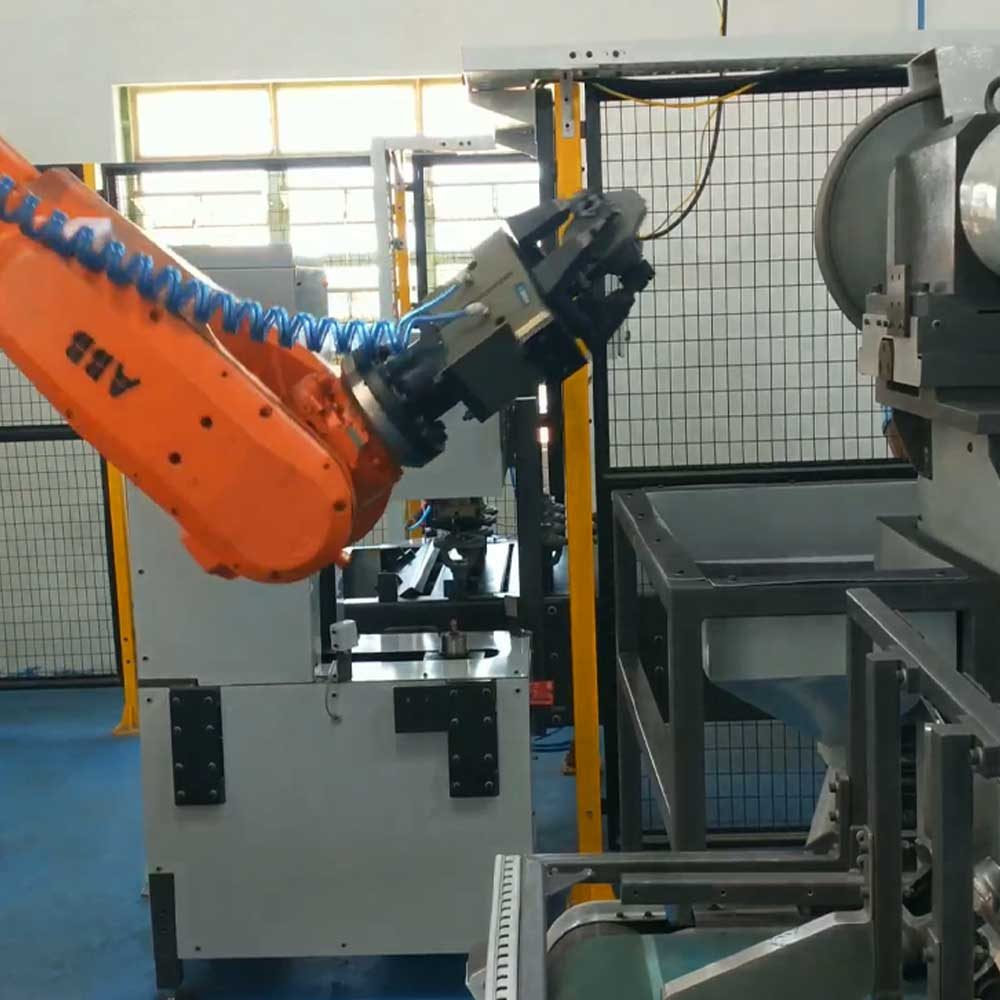
For smaller components, the robots can grip the components and present them to pedestal mounted grinding wheels. These special wheels are diamond coated for long life. The grinding unit is mounted on a pneumatic compensation unit. This is provided so that the robot does not get overloaded in case the runner/in gate material is excessive. For tight profiles and parting line flash removal smaller, milling cutters with indexable inserts can be used for material removal.
We have bulk in feed systems such as slat chain conveyors where an hour’s supply of components can be loaded. Vision systems can be utilized to locate the component and identify the location of the runner/in gate material to be removed. This eliminates the need for an operator to be present near the cell for loading/unloading. One operator can man multiple cells. This type of in feed system is suitable for smaller diameter circular components. Typical fettling times for these components are less than a minute.
For other complex shapes, simple laser cut fixtures mounted on indexing or rotary tables can be used for component in feed. These require frequent loading and the presence of a full time operator.
For heavier components, the components can be fed to the robots using a turntable or slide table. The component is fixtured in place. A robot mounted high speed HSK spindle can be utilized along with an array of tools mounted on a tool changer or rotary indexer. Typical cycle times are more than 3 minutes for these components due to the complexity and multiple tool changes required.
All our systems come standard with safety fencing and interlocking gates. Optional dust collection systems and sheet metal enclosures can be provided to reduce noise and dust.
BENEFITS OF ROBOTIC FETTLING
- Increased workplace safety for operators as exposure to dust and noise is eliminated
- Vision based identification of runners, risers and gates possible
- Enclosures can be provided to safeguard from dust and noise
- Heavy components such as brake drums and pump components can be handled by high payload robots
- Foundry specification robots can be used to increase lifespan
SUCCESFUL PROJECTS
YEARS OF EXPERIENCE
Industries Served
-
Foundry & Metal Casting
Automating the fettling process to remove excess material, burrs, and flash from castings, ensuring smooth and precise final products
-
Automotive
Streamlining the fettling of automotive cast components, such as engine blocks, ensuring high-quality, finished parts for vehicle production
-
Aerospace
Enhancing the fettling of critical aerospace components to meet stringent industry standards, ensuring smooth surfaces and dimensional accuracy
-
Heavy Machinery & Industrial Equipment
Automating the fettling of large cast parts used in heavy machinery, improving efficiency and reducing manual labor
FREQUENTLY ASKED QUESTIONS
Fettling is the removal of runners, risers, gates, flash, and other excess material left on a casting after it is removed from the mould. For grey and SG iron castings, this is mandatory before machining — excess material would damage cutting tools, prevent correct fixture loading, and stop the part meeting dimensional specifications. The process is labour-intensive and hazardous, generating grinding dust and noise while requiring sustained physical effort.
Smaller circular components are fed using a slat chain conveyor loaded with approximately one hour’s supply of components. A vision system locates each component and identifies the runner and in-gate material to be removed, so the robot can fettle each part without a dedicated operator at the cell. One operator can manage multiple such cells simultaneously. Optional bin picking systems can be provided.
The vision system identifies the component’s position and orientation on the conveyor, and locates where runner and in-gate material needs to be removed. This information is passed to the robot, which adjusts its pick path and fettling path accordingly. Without vision, each component would need to be manually fixtured in a known position, requiring an operator at every cycle.
The pneumatic compensation unit is mounted on the grinding wheel assembly and allows the wheel to give slightly under excess force. The volume of runner and in-gate material varies between individual castings. If the robot applies a fixed force against an unexpectedly large runner, the overload would damage the robot wrist or grinding unit. The compensation unit absorbs excess force, protecting the equipment while still removing the material.
Typically, smaller components can be fettled in less than one minute.
Heavier components are fed using a turntable or slide table, with the casting fixtured in place. The robot uses a high-speed HSK spindle at its wrist combined with a tool changer or rotary indexer holding an array of tools. The robot switches between tools during the cycle to handle different casting features. Typical cycle times for these complex components are more than 3-5 minutes due to the complexity and number of tool changes required.