Case packaging is a critical secondary packaging process, essential for efficiently handling high-volume production lines. Tens of thousands of unit cartons per hour are generated by FMCG, pharmaceutical, food and industrial product filling lines. These cartons must be accurately aligned and packed into larger retail cartons.
Multiple operators are typically needed to support the high-speed operations of filling and primary packaging lines.
Complete turnkey case packaging systems can be supplied with the following elements
- Carton erectors. These are dedicated and suitable for high speed lines running the same carton type. Only one carton type can be run at the same time. Manual or automatic setting change required for recipe change over
- Robotic Carton erectors – These systems are more flexible. One robot can service 3 to 4 lines with a variety of carton sizes. This provides an advantage over dedicated carton erectors
- Product in feed systems and collation conveyors. Both lane type and servo collators are used based on the SKU’s and flexibility required in the system
- Robotic grippers. Vacuum, pneumatic and servo grippers can be used. Tool changers can be used if separate grippers are required to handle multiple SKU’s
- Additional accessories such as online checkweighers, bar code readers and printers can be integrated into the line
- Bottom and Top sealers
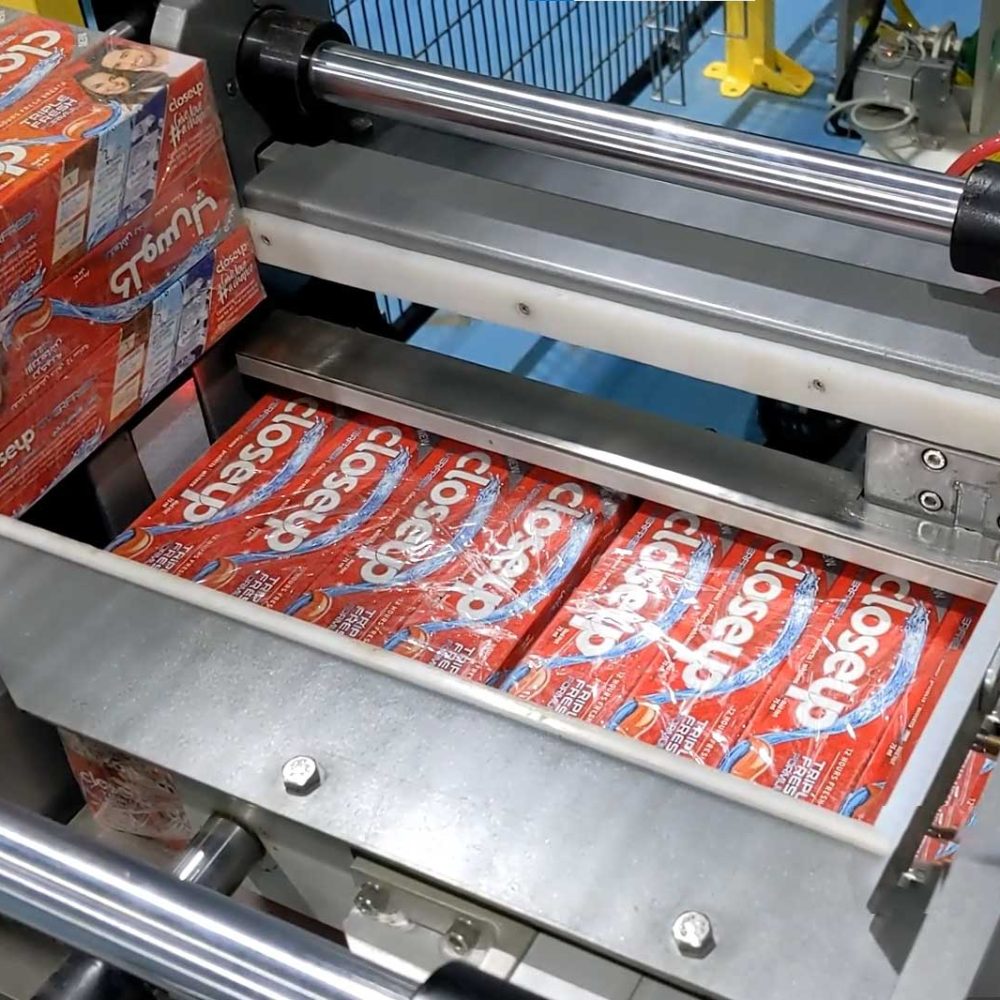
Our latest solution addresses the packaging needs of personal care product tube bundles for toothpaste, facial cream and moisturizing cream.
The customer required a highly flexible system capable of handling 15 variants ranging
from 50 to 250 grams, with a rapid recipe changeover time of under 10 minutes.
To meet these requirements, we implemented a robotic case erector and a servo collation unit. This combination offered the necessary flexibility and efficiency for the application. The robotic case erector eliminated the need for fixture changes, except for minor adjustments to the carton stacker. The robot has multiple programs to erect cartons of various sizes and bottom taping configurations.
An ABB IRB 1300 Robot was selected for its compact footprint and 13kg payload. This robot was easily able to erect 6 cartons per minute. For the layer formation, we used a servo collation unit combined with a servo pusher and receiver, offering infinite flexibility to handle the diverse range of bundle sizes. New variants can also be added with minimal fixturing.
While some minor fixturing changes were required for recipe changeover, we successfully achieved a changeover time well below the customer’s specified 10-minute target. This demonstrates the system’s adaptability and efficiency.
Our solution can be easily customized to accommodate a wide range of personal care and pharmaceutical products delivered in shrink-wrapped bundles. This versatility makes it a valuable asset for companies seeking to optimize their packaging processes.
BENEFITS OF ROBOTIC CASE PACKERS
- Flexibility for frequent recipe changes and minimal changeover time
- Easy to add new variants with minimal fixture investment
- Compact footprint when compared to conventional case packers
- Multiple case sizes can be acocmodated on the same line
SUCCESFUL PROJECTS
YEARS OF EXPERIENCE
Industries Served
-
Personal Care Products
Monocarton bundles for toothpaste, facial creams and moisturizers can be packed for retail shipment
-
Home care products
Detergents in containers & spout pouches, Cleaning Solutions in containers
-
Healthcare & Pharmaceutical products
Typical pharmaceutical creams and solutions packaged in monocartons and Personal medical devices are perfectly suitable for robotic case packers
-
Food and Beverage
Food packaged in glass bottles, milk and dairy products in tertrapacks, cut vegetables in pouches, products in FFS cartons and bulk products in EVOH bags need to be packaged in retail cartons for transport
-
Consumer Electronics
Smartphones, Tables, Laptops, smartwatches, digital cameras and a variety of consumer electronics need to be safely packaged for retail shipment
-
Industrial & Automotive Products
Lubricants, automotive spare parts, fasteners require case packaging
FREQUENTLY ASKED QUESTIONS
A dedicated carton erector is optimised for high-speed single-carton-type lines it runs one carton format at a time and requires a manual or automatic setting change for each recipe. A robotic carton erector is more flexible: one robot can service three to four lines with a variety of carton sizes, eliminating the need for fixture changes between formats (except minor adjustments to the carton stacker). The robot holds multiple programs for different carton sizes and bottom-taping configurations, making it the right choice for lines with frequent SKU changes.
Synapse Robotics has deployed the ABB IRB 1300 robot for carton erection. It has a compact footprint and a 13 kg payload, and can erect 6 cartons per minute. Its compact form factor makes it suitable for plants where floor space is constrained.
The servo collation unit combined with a servo pusher and receiver provides what the page describes as ‘infinite flexibility’ to handle diverse bundle sizes. New variants can be added with minimal fixturing. The collation unit adapts to different product dimensions and bundle matrix configurations without requiring replacement of major mechanical components.
A real-world deployment for a personal care manufacturer handling 15 variants from 50 to 250 grams achieved changeover well below the customer’s specified 10-minute target. The robotic carton erector eliminates fixture changes for carton size switches, and recipe changeover is handled through software selection, which is where most of the time saving comes from.
The system has been deployed for toothpaste, facial cream, and moisturizing cream tube bundles in personal care. It is also applicable to pharmaceutical creams, solutions, and personal medical devices in monocartons. Ffood and beverage products (glass bottles, tetrapacks, pouch-packed products, FFS cartons), consumer electronics (smartphones, tablets, laptops, smartwatches), and industrial/automotive products (lubricants, spare parts, fasteners).
A lane-type collator is suited to high-speed lines with a stable, limited range of SKUs it is faster but less adaptable. A servo collation unit uses independently controlled servo axes to form product into the required bundle matrix, meaning the bundle size and configuration can be changed through software rather than mechanical adjustment. This makes it the right choice for lines with many variants or frequent new product introductions.