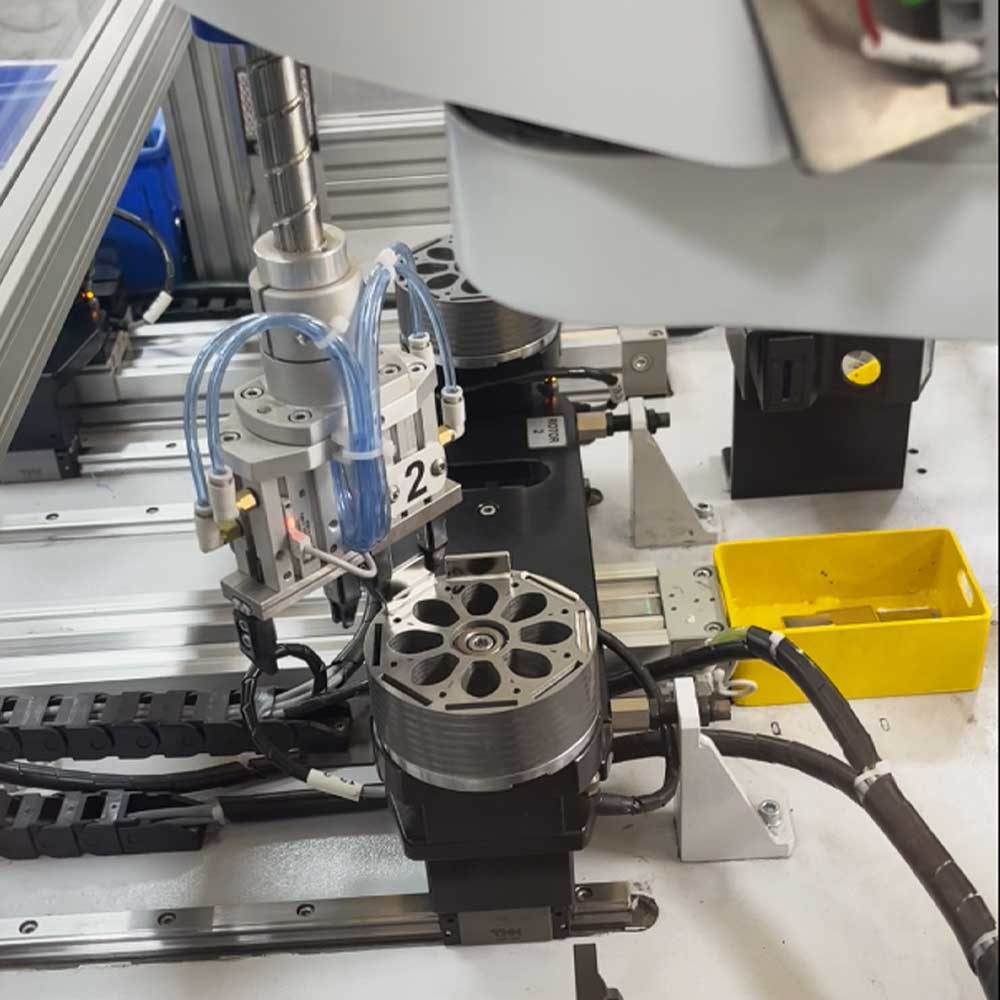
Glue dispensing is an application that requires high precision and consistency. SCARA robots or compact 6 axis robots are ideally suited for glue dispensing applications.
Combined with vision systems for bead dimension checking, robots can be used to dispense glue on a variety of components. Component feeding systems and operator loading stations can be integrated safely into the solution. Dual loading station ensure that the robot is fully utilized for dispensing thus improving productivity.
Lean Cells can be developed for glue dispensing applications based on the customer requirements
We integrate the following elements for perfect glue dispensing
- Infeed and outfeed system for part handling
- Operator stations for part feeding and removal
- Servo dispensing pumps for precise dipensing
- Vision or laser based monitoring for volume and dimensional accuracy
BENEFITS OF ROBOTIC GLUE DISPENSING
- High precision and consistency
- Material savings due to reduced wastage
- Operators are isolated from sticky substances and harmful chemicals
- Vision based monitoring for closed loop operation
- Flexibility in terms of new variant addition
SUCCESFUL PROJECTS
YEARS OF EXPERIENCE
Industries Served
-
Electronics
Electronics industry requires potting and gasketing. Circuit boards also require sealing and robots ensure high repeatability. Smart phone and Tablet assembly
-
Medical Devices
Medical devices such as syringes and catheters require adhesives to hold them together
-
Automotive
Automotive has several uses such as windshield bonding, gasket dispensing, headlamp sealing and EV battery assembly
-
LED Lighting and Solar
Potting of solar panel junction boxes and LED lens attachment and fixture sealing
FREQUENTLY ASKED QUESTIONS
Synapse uses SCARA robots or compact 6-axis robots for glue dispensing applications. SCARA robots are ideally suited for planar dispensing tasks requiring fast horizontal motion. Compact 6-axis robots are used where the dispensing path requires movement along more complex trajectories. The robot type is selected based on the component geometry and the dispensing path required.
A typical Synapse glue dispensing cell integrates four key elements: an infeed and outfeed system for part handling, operator loading and unloading stations, servo dispensing pumps for precise application, and a vision or laser-based monitoring system for verifying bead volume and dimensional accuracy. These elements are combined into a complete cell tailored to the customer’s component and production requirements.
The cell is designed with dual loading stations — while the robot is dispensing on one part, the operator loads or unloads at the other station. This ensures the robot is continuously dispensing rather than waiting for parts to be loaded. The result is higher robot utilisation and improved overall productivity from the cell.
Vision or laser-based monitoring is integrated for closed-loop quality control. After dispensing, the system checks the bead for dimensional accuracy and volume — confirming that the correct amount of adhesive was applied along the correct path. This closed-loop feedback enables the system to detect dispensing faults immediately rather than relying on downstream inspection.
The main benefits are high precision and consistency in bead placement, material savings from reduced adhesive wastage, improved operator safety by isolating workers from sticky substances and potentially harmful chemicals, and flexibility to accommodate new product variants without significant reconfiguration. Vision-based monitoring also enables continuous quality verification that is not practical with manual dispensing.
In manual glue dispensing, operators are in continuous contact with adhesives and sealants — many of which are sticky, chemically irritating, or require solvent-based cleaning agents for hand cleaning. Some industrial adhesives also release fumes during application. Robotic dispensing removes operators from this exposure entirely, isolating them from direct contact with the substances while still allowing safe loading and unloading of parts at designated operator stations.