
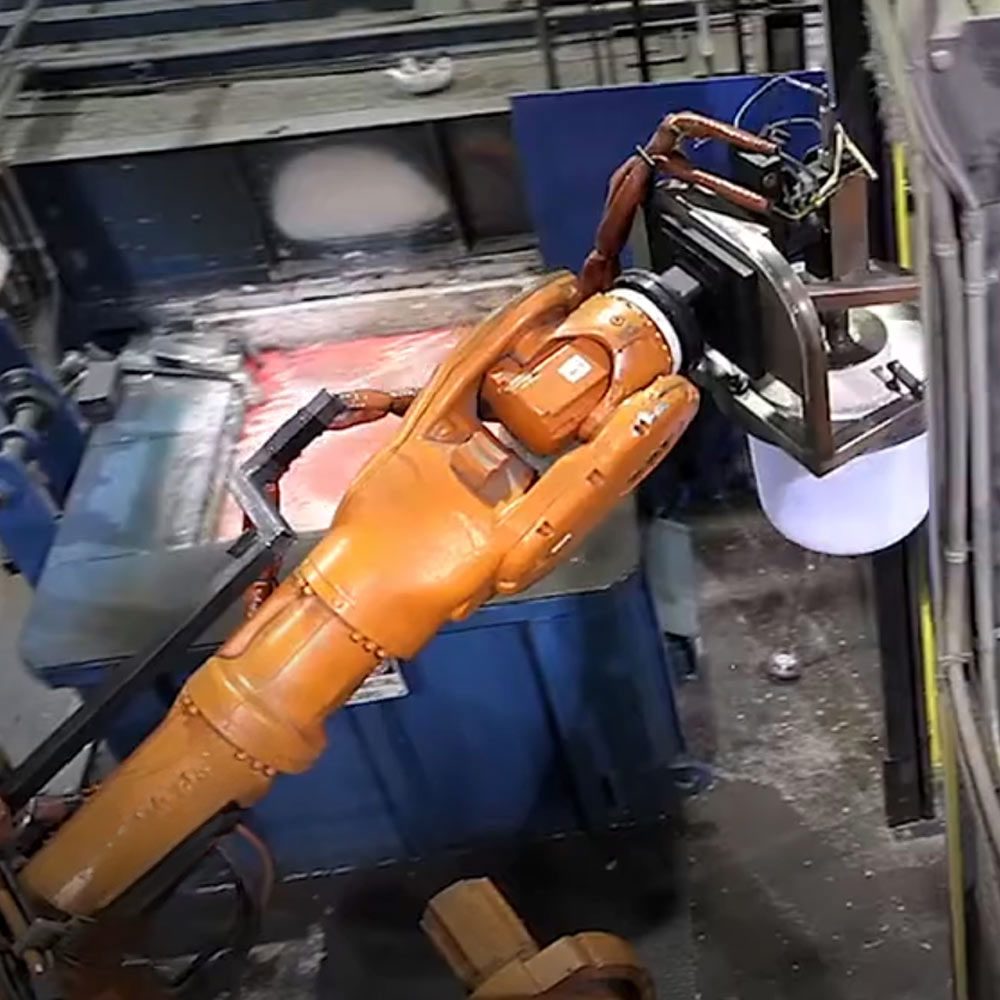
Handling molten metal is a risky task for humans. Hot environments and smoke causes fatigue for the operators Foundry specification robots are ideally suited for handling molten metal. Aluminium Pressure die casting and Gravity die casting require precision ladling for consistent shot weights and reduced scrap. Robots equipped with custom ladles, servo tilting mechanisms, heat shields and thermocouples ensure very high consistency and improved quality. GDC machines also require precision tilt pouring to minimize casting defects. All our systems come standard with safety fencing and interlocking gates.
ENSURING OPERATOR SAFETY
- Increased workplace safety for operators as exposure to heat and hot molten metal is eliminated
- Operators are freed from inhalation of toxic and potentially carcinogenic smoke emanating from molten metal
- Lower absenteeism and a safer cleaner work is ensured.
SUCCESFUL PROJECTS
YEARS OF EXPERIENCE
Industries Served
-
Foundry & Metal Casting
Aluminum components are widely used in all sectors such as automotive, aerospace, home appliance and lighting to name a few and metal ladling robots help improve the consistency of the components
FREQUENTLY ASKED QUESTIONS
Aluminium Pressure Die Casting (PDC) and Gravity Die Casting (GDC) are the two processes specifically highlighted on this page. PDC requires precision ladling to deliver consistent shot weights and reduce scrap. GDC requires precision tilt pouring to minimise casting defects. Both benefit from the repeatability that robotic ladling provides compared to manual pouring.
Synapse equips its metal ladling robots with custom ladles designed for the specific alloy and ladle volume required, servo tilting mechanisms that control pour angle and speed, heat shields to protect the robot wrist and tooling from radiant heat and splash, and thermocouples for temperature monitoring.
Standard industrial robots are not designed for the foundry environment — high ambient temperatures, metal splash, airborne smoke and fumes, and radiant heat from molten metal rapidly degrade standard seals, lubricants, and electrical components. Foundry-specification robots are built to withstand these conditions, with appropriate protective measures for motors, encoders, and other sensitive components.
In Gravity Die Casting, the mould is tilted during pouring so that metal enters smoothly, reducing turbulence and the air entrapment that causes defects such as porosity. A robot can precisely control the speed and angle of the tilt throughout the pour cycle — something a manual operator cannot replicate consistently over many pours. This directly reduces scrap from defective castings.
Casting quality in both PDC and GDC is directly influenced by shot weight consistency and pour characteristics. A robot delivers the same ladle fill, pour speed, and tilt angle on every cycle, eliminating variation from operator fatigue, technique differences between shifts, and inconsistent ladle filling. Consistent shot weights mean more predictable mould fill and fewer defects.