
HOT FORGING
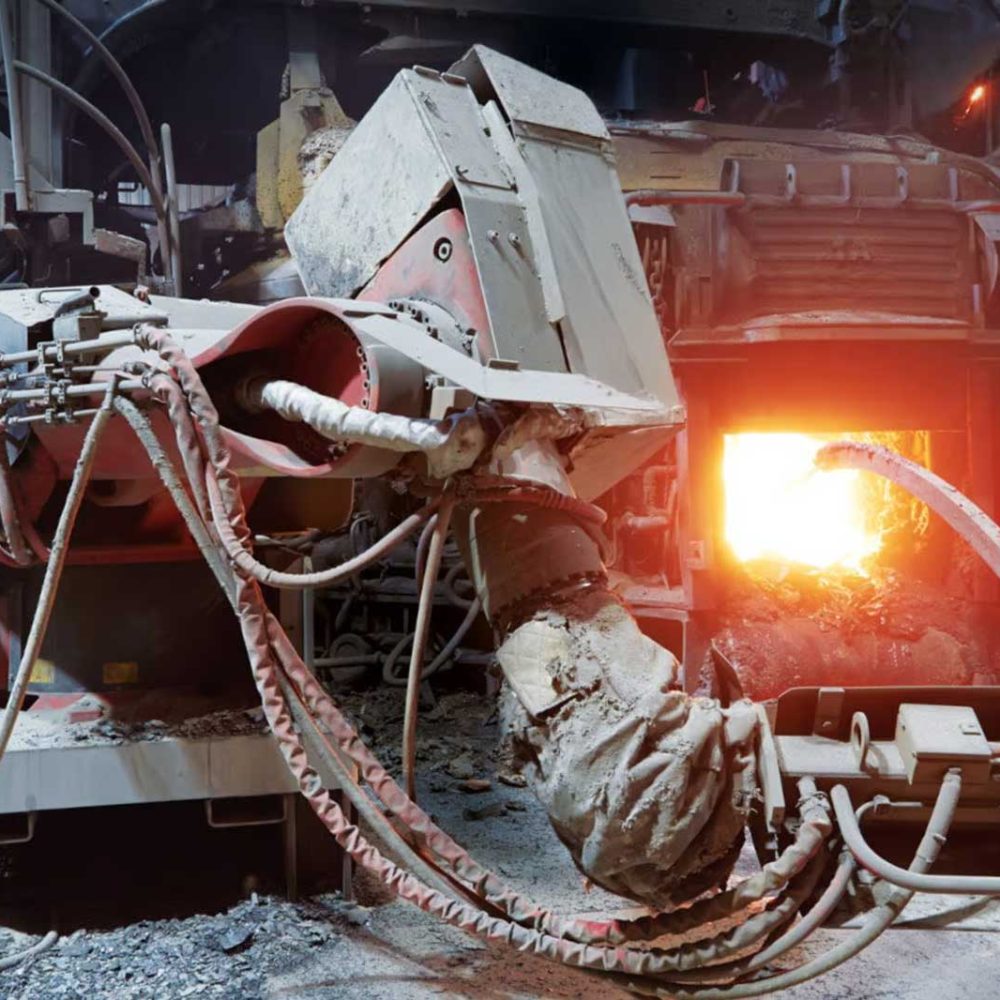
Forging presses have very short cycle times, usually less than 5 seconds. Loading presses can be a tiresome operation for the operator. Robots can be deployed to pick up the hot billets from the induction furnace and load to the 1st stage (forming). As required, the same robot can be utilized to transfer to the subsequent stages of forming and trimming. 2 or 3 stage presses require multiple handling and precision loading. 2 operators are required to work in tandem. This poses a huge risk while handling red hot billets. Die spraying tasks can also be automated.
For individual smaller presses, the component needs to be transferred from one press to another to complete the operation. The critical factor is time. All operations need to be completed within a certain time so that the component temperature is maintained before the final shape is attained. 2-3 operators are required to work in close proximity and this multiple presses and the risk posed due to the hot components is very high.
COLD FORGING
Cold forging presses have a similar requirement but with lower risk. We can offer complete turnkey solutions for unmanned operation of cold forging presses.
Installation of Robots can help by eliminate the above fatigue and risk factors associated with press loading. Foundry grade robots can be used along with heat shields to prolong the life of the robots.
We integrate the following elements for perfect forging press tending
- Bulk Load Billet feeders
- Step & Elevator feeders
- Gravity cut bit feeders
- Lubrication systems
- Billet orientation sensing devices
- Temperature sensing devices for quality assurance
BENEFITS OF ROBOTIC FORGING PRESS TENDING
- Elimination of operator fatigue due to noise, vibration, temperature and smoke inhalation
- Elimination of risk of injury due to hot component handling
- Quality improvement - Rejections and inconsistency due to temperature loss will be significantly reduced
- Productivity improvement - Typically Robot fed presses will produce 30% more than manually operated presses.
- Flexibility - Easily reprogrammable for variant changes when compared to walk beam loaders
SUCCESFUL PROJECTS
YEARS OF EXPERIENCE
Industries Served
-
Automotive
The automotive industry is a a major consumer of forged components. Engine, transmission, steering and suspension parts are typically forged because of the complex shapes required
-
Power generation and transmission
Power industries heavily rely on forgings. Nearly 40% of parts for this industry are forged. Components such as turbine blades, shafts, discs and generator components are formed by forging
-
Agricultural & Mining
Axle hubs, pinions, drill bits, shafts are forged due to high wear resistance. Robots form an integral part of tending to forging machines
-
Aerospace
Landing gear parts, turbine blades, compressor parts and structural components are ideally suited for robotic tending
FREQUENTLY ASKED QUESTIONS
Hot forging presses have very short cycle times — typically less than 5 seconds. Loading a press manually at this frequency is a demanding and tiring operation. More critically, for multi-press operations, components must be transferred from one press to another and all operations completed within a defined time window to maintain the billet’s temperature before the final shape is achieved. A robot can execute these transfers consistently and at the required pace, eliminating both the human fatigue and the temperature-loss variability that result from manual transfer.
In a 2-stage or 3-stage hot forging press, 2 operators typically work in tandem, handling red-hot billets between forming and trimming stages. The risk is significant: operators are exposed to radiant heat, noise, vibration, and smoke inhalation throughout the shift. For individual smaller presses where components must be transferred between multiple presses, 2 to 3 operators work in close proximity to each other and to hot equipment simultaneously, compounding the risk. Robotic tending eliminates operators from the hot zone entirely.
The same robot that picks up hot billets from the induction furnace and loads the first stage (forming) can be utilised to transfer to subsequent stages of forming and trimming. This means a single robot can manage the complete sequence for a 2 or 3-stage press, handling the multi-stage transfer and precision loading that previously required 2 operators working in coordination.
Robot-fed presses typically produce approximately 30% more output than manually operated presses. This improvement comes from consistent cycle timing — a robot does not slow down due to fatigue, heat exposure, or distractions — and from eliminating the delays associated with manual transfer between press stages.
Foundry-grade robots are used for hot forging applications. These are built to higher environmental standards than standard industrial robots, with improved sealing and heat-resistant construction. Heat shields can be added to prolong the robot’s service life in environments with high radiant heat from billets and furnaces. Proper gripper and end-of-arm tooling selection for heat resistance is also part of the cell design.
Available auxiliary systems include: bulk-load billet feeders, step and elevator feeders, gravity cut-bit feeders, lubrication systems for die spraying, billet orientation sensing devices, and temperature sensing devices for quality assurance. Temperature sensing is particularly important — it confirms that each billet is within the correct temperature range before loading, preventing rejected parts due to insufficient forging temperature.
Yes. Die spraying — applying lubricant to the dies between press cycles — can be automated using the same robot or a dedicated spray system integrated into the cell. Automating die spraying removes an additional operator task from the press area, reduces the variability of die coating application, and contributes to more consistent part quality and die life.
Automotive manufacturing is the largest consumer of forged components — engine, transmission, steering, and suspension parts are forged for complex shapes and strength. Power generation and transmission rely heavily on forgings for turbine blades, shafts, and generator components (approximately 40% of parts in this sector are forged). Agricultural and mining equipment uses forged axle hubs, pinions, drill bits, and shafts for wear resistance. Aerospace produces landing gear parts, compressor parts, and structural components through forging.