
Precision deburring of machined components is a strenuous and boring job for operators. VMC’s and HMC’s can produce components in large numbers and all of these components require deburring before assembly. Deburring can also be completed using the same machines, but it is inefficient to utilize expensive machines for post process operations.
Typically manual deburring requires the use of multiple tools such as pneumatic rotary tool, files, hand scrapers, reamers, countersinks and abrasive pads. Operators have to follow a particular sequence to get the required results and aesthetics.
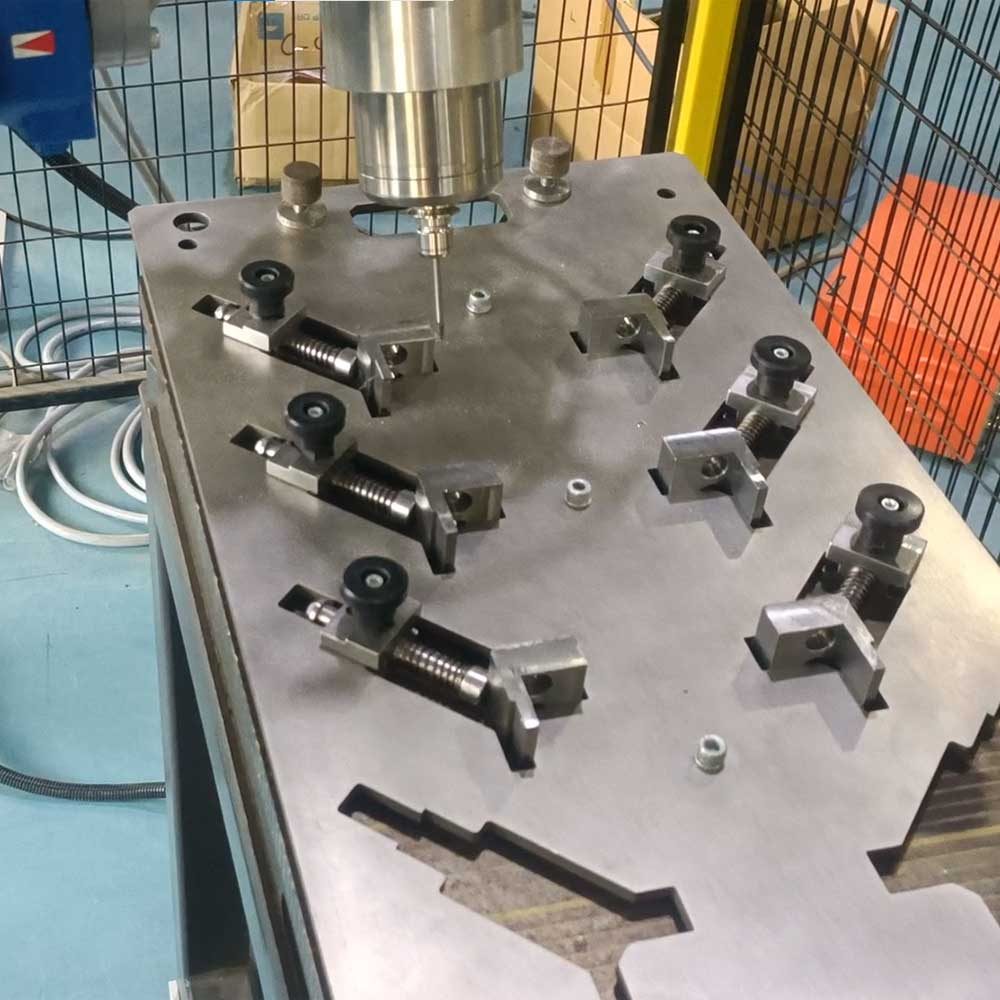
6 axis robots equipped with high speed spindles and tool changers are perfectly suited for precision deburring applications
We have developed a unique solution for precision deburring
- Specialized compliant spindle with tool changer and speed variation from 3000 to 30000 RPM
- Customized fixturing with a magnetic table for quick component changeover
- Flexibility to use tools from silicon carbide and aluminium brushes that require low speed operation to tungsten carbide burrs that require to run at high speeds
- Dual stations for improved efficiency
BENEFITS OF ROBOTIC DEBURRING
- Consistent results and improved aesthetics of the end product
- Eliminates dull and repetitive job for the operator
- Complex shapes can be easily deburred
- Offline programming using simulation software to increase robot utilization
- Consistent and uniform force can be applied for precise material finishing
SUCCESFUL PROJECTS
YEARS OF EXPERIENCE
Industries Served
-
Automotive
High precision components such as gears, manifolds, ports and valves require precision deburring before assembly
-
Aerospace
Components such as turbine blades, structural components and fuel system parts require tight tolerances and force controlled deburring is required
-
Healthcare
Medical implants and surgical tools need to have a very smooth and burr free surface to meet biocompatibility and hygiene standards
-
Electrical components
Electrical connectors and components need deburring to prevent short circuits and failed connections.
FREQUENTLY ASKED QUESTIONS
VMCs and HMCs are expensive, high-precision machines designed for cutting operations. Using them for deburring — a post-process finishing operation — ties up machine capacity that could otherwise be used for productive machining.
Manual deburring requires operators to use multiple tools in a specific sequence — pneumatic rotary tools, files, hand scrapers, reamers, countersinks, and abrasive pads — and to follow a particular order to achieve the required finish and aesthetics. The sequence and the force applied vary between operators, between shifts, and as operators fatigue during a long run. The result is inconsistency in both finish quality and cycle time.
6-axis robots are specified for precision deburring, combined with high-speed spindles and tool changers. The 6-axis configuration provides the range of motion needed to approach complex component surfaces from multiple angles. A specialized compliant spindle with a tool changer is used, covering speeds from 3,000 to 30,000 RPM.
A compliant spindle is a motorised tool holder that can deflect slightly under load — it has a degree of built-in compliance. In deburring, the amount of burr material varies between individual components. A rigid spindle on a fixed path would skip shallow burrs or stall on large ones; a compliant spindle maintains surface contact and removes material consistently regardless of these variations.
The spindle covers 3,000 to 30,000 RPM. This wide range is necessary because different tools and materials require very different speeds — silicon carbide and aluminium brushes for gentle finishing operate at low speeds, while tungsten carbide burrs for harder material removal need high speeds. A single spindle covering this range allows the system to handle multiple deburring operations in one cell without a spindle change.