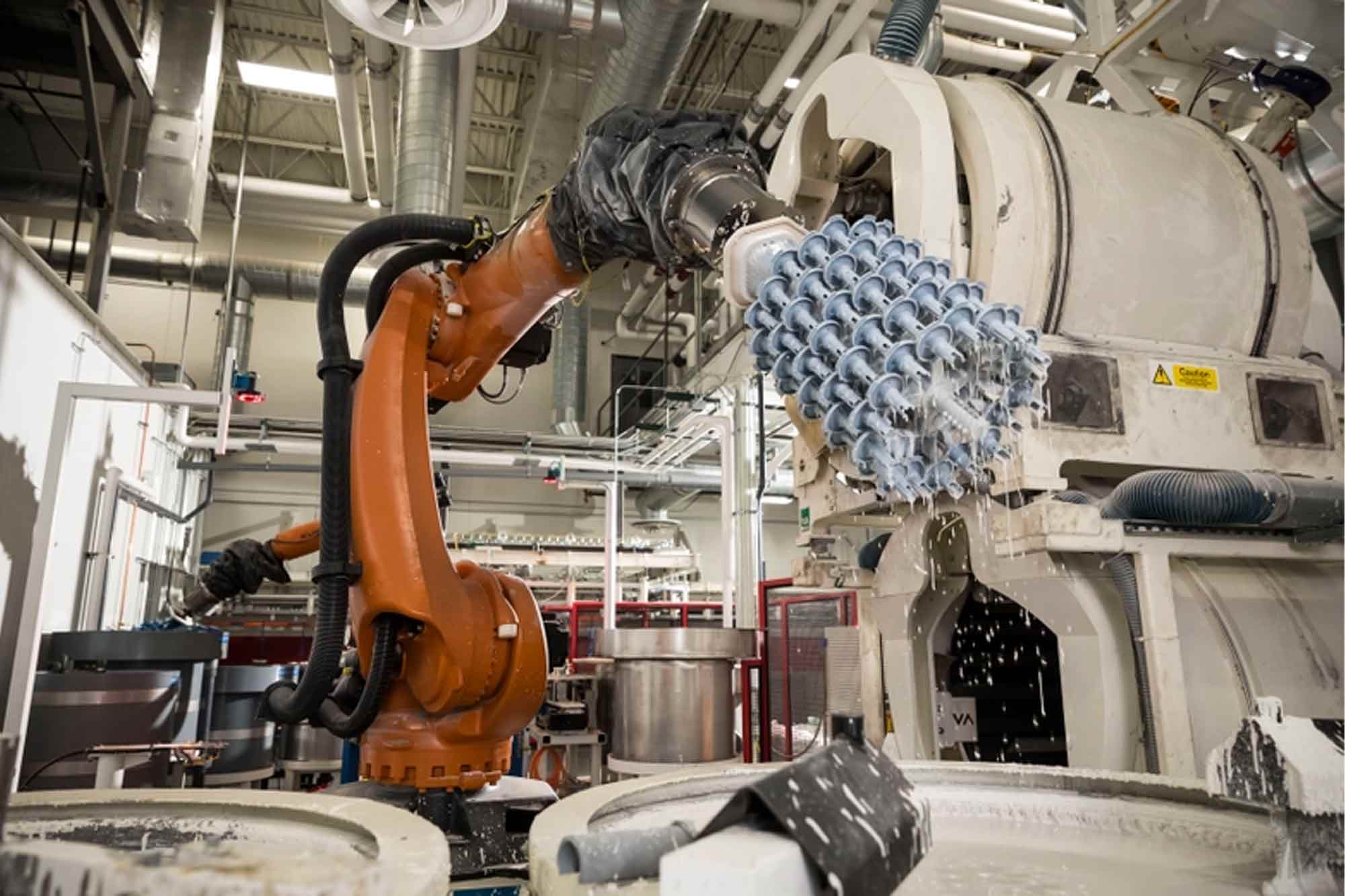
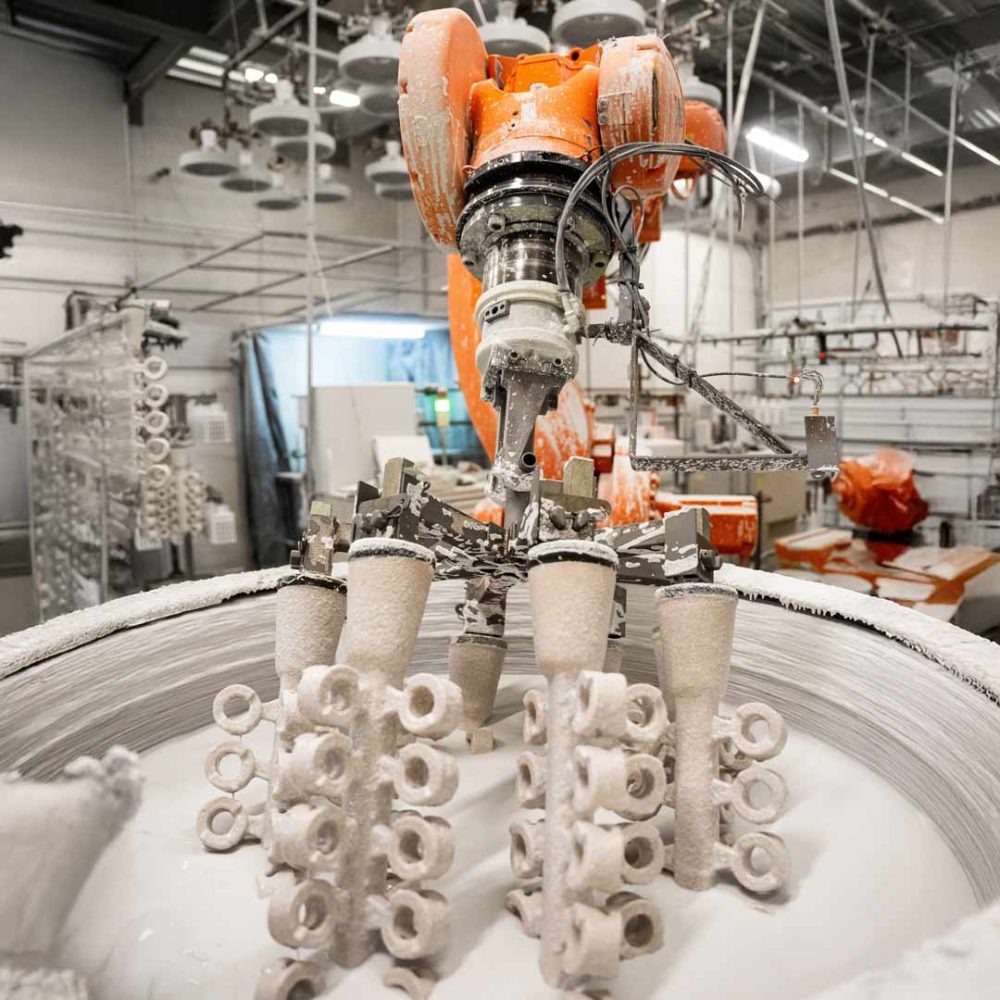
Slurry dipping of investment casting wax patterns is a fatigue inducing job for operators. Robots equipped with special free rotating end of arm tools make the slurry dipping and coating process very repeatable. This results in minimal coating defects and uniform shell thickness. Robots maintain the exact dipping times and motion paths 6 axis robots equipped with high speed spindles and tool changers are perfectly suited for precision deburring applications
We have developed a unique solution for precision deburring
- Specialized compliant spindle with tool changer and speed variation from 3000 to 30000 RPM
- Customized fixturing with a magnetic table for quick component changeover
- Dual stations for improved efficiency
- Flexibility to use tools from silicon carbide and aluminium brushes that require low speed operation to tungsten carbide burrs that require to run at high speeds
BENEFITS OF ROBOTIC DEBURRING
- Consistent results and improved aesthetics of the end product
- Eliminates dull and repetitive job for the operator
- Complex shapes can be easily deburred
- Offline programming using simulation software to increase robot utilization
- Consistent and uniform force can be applied for precise material finishing
SUCCESFUL PROJECTS
YEARS OF EXPERIENCE
Industries Served
-
Automotive
High precision components such as gears, manifolds, ports and valves require precision deburring before assembly
-
Aerospace
Components such as turbine blades, structural components and fuel system parts require tight tolerances and force controlled deburring is required
-
Healthcare
Medical implants and surgical tools need to have a very smooth and burr free surface to meet biocompatibility and hygiene standards
-
Electrical components
Electrical connectors and components need deburring to prevent short circuits and failed connections.
FREQUENTLY ASKED QUESTIONS
Investment casting slurry dipping is the process of coating wax patterns in ceramic slurry to build the shell mould used in investment casting. Each pattern must be dipped and allowed to dry multiple times to build sufficient shell thickness. The process is repetitive and physically tiring, and requires precise, consistent motion to produce a uniform coating — making it well suited to robotic automation.
Each dipping cycle requires the operator to hold and manoeuvre a wax cluster through a controlled dipping and rotating motion in the slurry tank. The wax clusters can be heavy, the motion must be precise, and the process is repeated many times across a shift. The page describes it as a fatigue-inducing job, which means manual quality degrades as the shift progresses.
A robot repeats the same dipping path, dwell time, and withdrawal speed on every cycle and every shift. This eliminates the variation in dipping angle, submersion time, and withdrawal rate that occurs with manual dipping — particularly as operators fatigue. This results in minimal coating defects and uniform shell thickness.
The ceramic shell is the mould into which molten metal is poured. Uneven thickness means uneven mechanical strength — thin areas may crack under the thermal shock of pouring, and uneven thickness also affects heat dissipation and the casting solidification pattern. Uniform shell thickness from consistent robotic dipping directly supports better casting quality and lower shell failure rates.
Key inputs include: wax cluster dimensions and weight, required dipping sequence and number of coats, slurry tank dimensions and layout, target cycle time including drying intervals between coats, available floor space, and any special requirements for cluster handling or orientation. This allows the robot model, end-of-arm tooling, and cell layout to be matched to the actual process.