Consistent 6–7 second extraction. 25%+ off-shift productivity. Zero operator exposure to 600°C die heat.
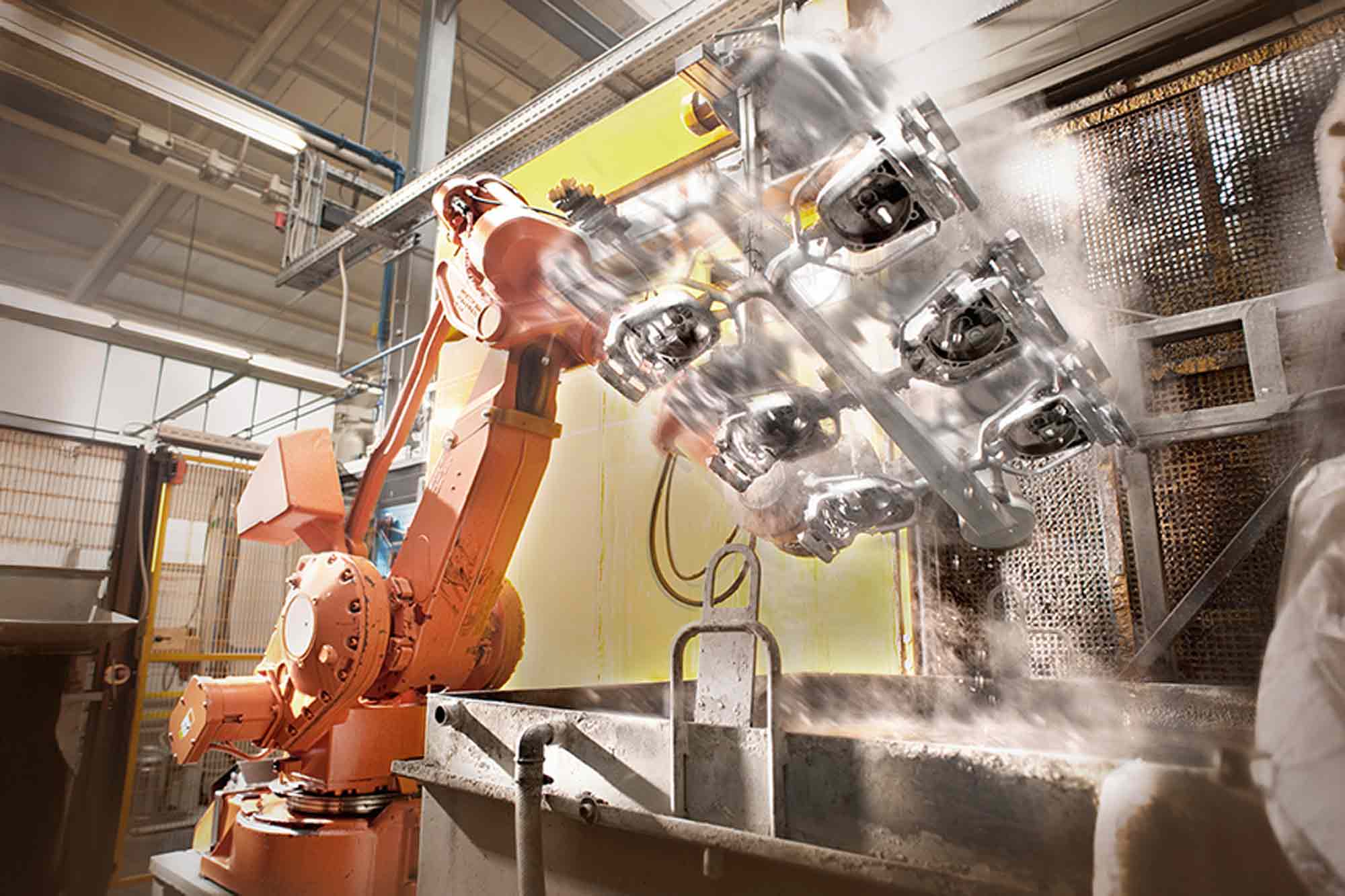
Manual extraction from aluminium die casting machines is the highest-risk, most repetitive job on the foundry floor — operators reach into a 600°C thermal environment every 45 seconds, shift after shift. Fatigue, heat stress, and fume exposure make this an operator retention problem more than a productivity problem. Synapse Robotics’ turnkey PDC and GDC machine tending cells eliminate operators from the extraction zone entirely, delivering consistent 6–7 second extraction cycles, measurable OEE gains on the melting and holding furnaces, and over 25% productivity uplift on off-shifts — with proven deployments across automotive, EV, and lighting sector customers.
Robotic Tending vs Manual Extraction
Parameter
- Extraction cycle time
- Off-shift productivity
- Die heat loss between shots
- Scrap rate
- Operator heat exposure
- Fume / smoke inhalation
- Operator fatigue impact
- New Variant addition
- Energy cost (furnace OEE)
- Insert placement accuracy
Manual Extraction
- 12–20 sec (variable)
- Typically 60–70% of day shift
- Higher — longer idle time
- Higher (die temp variation)
- Every cycle — 600°C environment
- High — release agent spray proximity
- Degrades after 3–4 hours
- Operator retraining required
- Lower — idle time extends furnace run
- Variable
Robotic Machine Tending
- 6–7 sec (consistent)
- 25%+ higher than manual off-shift
- Minimised — faster re-close
- Lower (consistent extraction timing)
- Eliminated
- Eliminated
- None — consistent 24/7
- Program update — hours, not days
- 15–20% saving via improved OEE
- Repeatable to ±0.1 mm
25%+ Increase in Off-Shift Productivity
Night-shift operators are typically 25% less efficient than the day shift operators – a known reality driven by fatigue and reduced supervision. A robot operates at the same cycle speed and consistency at 3 AM as it does at 3 PM. A robot neutralizes this inefficiency. For high-volume automotive customers running 24/7 shifts, this is frequently the single largest ROI driver.
15–20% Energy Savings via Furnace OEE
The melting and holding furnaces must maintain molten aluminium at 650–720°C throughout the production window, regardless of whether the die casting machine is cycling or idle. Every second the machine sits idle between shots (waiting for manual extraction) is furnace energy spent with no output. Consistent 6–7 second robot extraction reduces idle time per cycle, meaning more shots are produced per furnace-hour. The 15–20% energy saving per unit of output follows directly , thus improving OEE
Reduced Scrap from Die Temperature Stability
Aluminium PDC quality is highly sensitive to die temperature. A die that sits open and idle for 15 seconds loses significantly more heat than one closed within 7 seconds. Consistent, fast extraction keeps the die temperature in its optimal working range, reducing cold shuts, misruns, and porosity defects – all leading causes of scrap in die casting.
BENEFITS OF ROBOTIC TENDING
- Zero Operator Exposure to 600°C Die Heat
- 25%+ Increase in Off-Shift Productivity
- 15–20% Energy Savings via Furnace OEE
- Reduced Scrap from Die Temperature Stability
- Faster Changeover for New Component Variants
SUCCESFUL PROJECTS
YEARS OF EXPERIENCE
Industries Served
-
Automotive & Two-Wheeler
Transmission housings, cylinder heads, oil sumps, brackets, structural castings
-
EV / Electric Vehicle
Battery end-plates, motor housings, inverter enclosures, EV structural frames
-
Lighting
LED heatsink bodies, luminaire housings, street light components
-
Household Appliances
Compressor bodies, motor end-shields, pump housings
-
Electrical & Power
Switchgear enclosures, busbar connectors, metering components
-
Pharmaceutical Equipment
Pump bodies, valve housings, equipment frames
-
Defence & Aerospace
Structural brackets, connector housings, equipment enclosures
-
Industrial Machinery
Gearbox covers, hydraulic manifolds, instrument housings
Secondary Operations
Die Spraying
Insert Placement
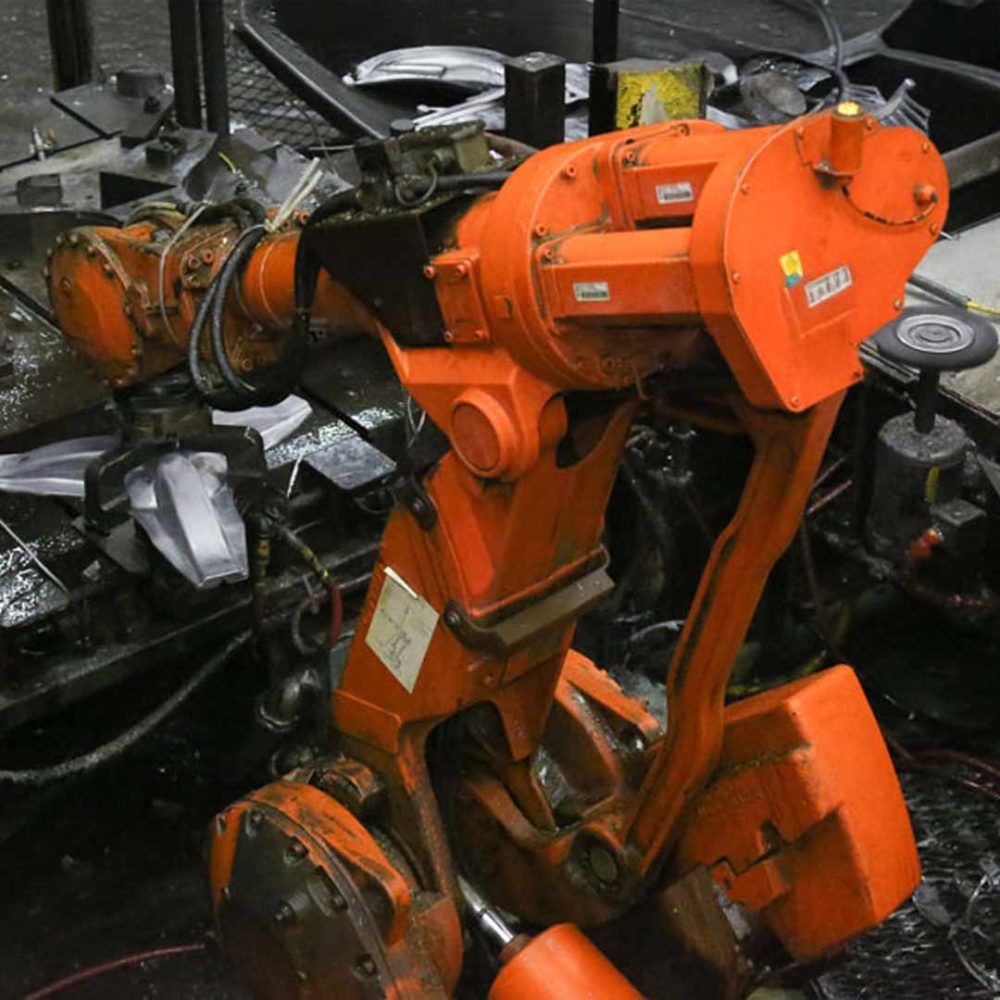
For components requiring metallic inserts (threaded bushes, reinforcement sleeves, bearing housings), the robot picks inserts from a feeder and places them into the die at precise location before each shot. This eliminates incorrect insert placement – a common defect cause in high-mix PDC operations.
Quenching
Freshly extracted aluminium castings at 300–400°C must be cooled rapidly to enable downstream handling and trimming. The robot transfers the component directly into a quench bath or spray station, controlling immersion time and orientation – within the machine idle window, so no cycle time is added.
Trimming Press Loading
Gates, runners, and flash are removed in a separate trimming press. The robot loads the quenched component into the trimming press, waits for the trim cycle, and removes the finished component to the output conveyor.
Gate Presence Checking
Before each new shot, the robot or an integrated sensor verifies that all gates and runners from the previous cycle have been completely removed. A failed gate check halts the cycle and triggers an alarm, preventing die damage from a double-pour.
Runner and Riser Cutting
For GDC applications where runners and risers are not trimmed in a press, the robot presents the casting to a cut-off saw station integrated into the cell — no operator handling of hot, sharp castings required.
Why Choose Synapse Robotics
- 12+ years of robotics integration experience across foundry, automotive, and FMCG sectors
- 100+ successful automation projects delivered and commissioned in India
- 100% retention payment receipt record - customers complete payment after successful deployment
- Less than 2% revenue from spares - reflects the long-term reliability of deployed systems
- Turnkey delivery - mechanical design, robot programming, electrical panels, safety fencing, commissioning, and operator training all in-house
- Post-commissioning support from our local base
FREQUENTLY ASKED QUESTIONS
In PDC (Pressure Die Casting), molten aluminium is injected at high pressure into a closed steel die. Cycle times are short (30–60 seconds), and extraction forces can be higher because the part is still warm and adhering to the die. In GDC (Gravity Die Casting), the metal fills by gravity – cycle times are longer (60–180 seconds), component wall thicknesses are typically greater, and the extraction is gentler. The robot cell design and gripper specification differ: PDC cells optimise for speed, GDC cells optimise for controlled extraction and heavier payloads.
Typical extraction cycle times are 6–7 seconds from die open signal to component clear. This compares to 12–20 seconds for manual extraction (variable due to heat and fatigue). The 6–7 second figure is consistent across shifts – it does not degrade at hour 6 of a night shift the way manual performance does.
The melting and holding furnaces run continuously to keep metal at 650–720°C. Every second the die casting machine sits idle (waiting for manual extraction) is furnace energy spent with no output. Consistent 6–7 second robotic extraction reduces per-cycle idle time significantly, which directly improves OEE of the furnace – compounding into the 15–20% energy saving per unit of output that Synapse has measured on deployed systems.
Synapse Robotics integrates with all major die casting machine brands – Bühler, Italpresse, Zitai, and other OEM machines. Integration requires access to the machine’s PLC or cycle signals (die open, die close, shot complete). Synapse’s engineers handle the electrical and signal integration as part of the turnkey scope.
Robot payload selection depends on component weight plus gripper tooling weight. For light automotive PDC parts (0.2–2 kg), 25–50 kg payload robots are typical. For larger PDC structural castings (2–10 kg), 165 kg payload robots are selected for the reach. Synapse will specify the robot model after reviewing your component drawing and machine specifications.
Grippers for PDC/GDC tending are designed for thermal resilience. Finger materials are selected to handle component temperatures of 200–400°C at extraction. Cooling air circuits are typically integrated into the gripper to manage heat buildup over multiple cycles. Gripper design is part of Synapse’s in-house mechanical engineering scope.
For a new component with similar geometry and weight to an existing part, a program changeover typically takes 4 hours – including updating the robot path, gripper finger change if needed, and test cycles. For a completely new component family requiring a new gripper, allow 1–2 days. Synapse provides changeover training to your maintenance team during commissioning.
Gate presence checking can be implemented using 2D machine vision cameras (Cognex, Keyence, or equivalent) or simple proximity sensors depending on the complexity of the detection task. For straightforward gate/runner presence (binary check), a photoelectric or inductive sensor is typically sufficient and cost-effective. For complex multi-gate geometries, a 2D vision system with image comparison logic is recommended.
Within a single machine cycle, the robot can also perform: die spraying (applying release agent), insert placement (loading metal inserts before each shot), component quenching, trimming press loading, gate presence checking, and runner/riser cutting at an integrated cut-off saw. These secondary operations are performed within the machine’s idle window they add zero time to the overall cycle.
ROI periods vary by shift pattern, labour cost, component volume, and scrap reduction achieved. For a two-shift or three-shift foundry running high-volume automotive parts, ROI periods of 2–3 years are typical – driven by off-shift productivity gain, reduced scrap, and energy savings. Synapse can prepare a site-specific ROI calculation based on your cycle time, shift count, and current productivity data.
Synapse’s turnkey scope covers: process consultation and application study, robot and end-of-arm tooling specification, mechanical design of the cell (fencing, fixturing, conveyors), electrical panel design and wiring, robot programming and simulation, factory acceptance testing, site installation and commissioning, and operator/maintenance training. Post-commissioning support is provided from our Coimbatore base.
FREQUENTLY ASKED QUESTIONS
In Aluminium Pressure Die Casting (PDC) and Gravity Die Casting (GDC), the robot’s primary task is to extract the freshly cast component from the die casting machine at the end of each machine cycle. Based on the machine cycle time of approximately 45 seconds. The robot can also perform secondary tasks: quenching the component, loading it into a trimming press, and in some cases cutting runners and risers using a cut-off saw.
The page states that typical cycle times of 6–7 seconds can be achieved for component extraction. This consistent extraction time directly affects the die casting machine’s cycle efficiency.
If a human extracts the component manually, extraction time varies due to fatigue, distractions, or difficulty handling a hot part. Any delay extends the total machine cycle. A robot extracting consistently in 6–7 seconds reduces idle time between cycles, increasing the number of shots produced per shift. There is a significant productivity improvement, particularly on off-shifts.
More than 25% increase in productivity on off-shifts can be achieved resulting in a 15–20% energy savings due to increased OEE of the melting and holding furnaces.
The melting and holding furnaces must maintain molten metal at temperature throughout the production window. If the die casting machine cycles faster due to consistent robot extraction, more components are produced in the same time with the same furnace energy input. There is also less heat loss from dies between cycles leads to reduced scrap — another indirect benefit of faster, more consistent extraction.
Ready to Improve Your Foundry Productivity?
Let’s build a safer, smarter and more productive foundry together.